

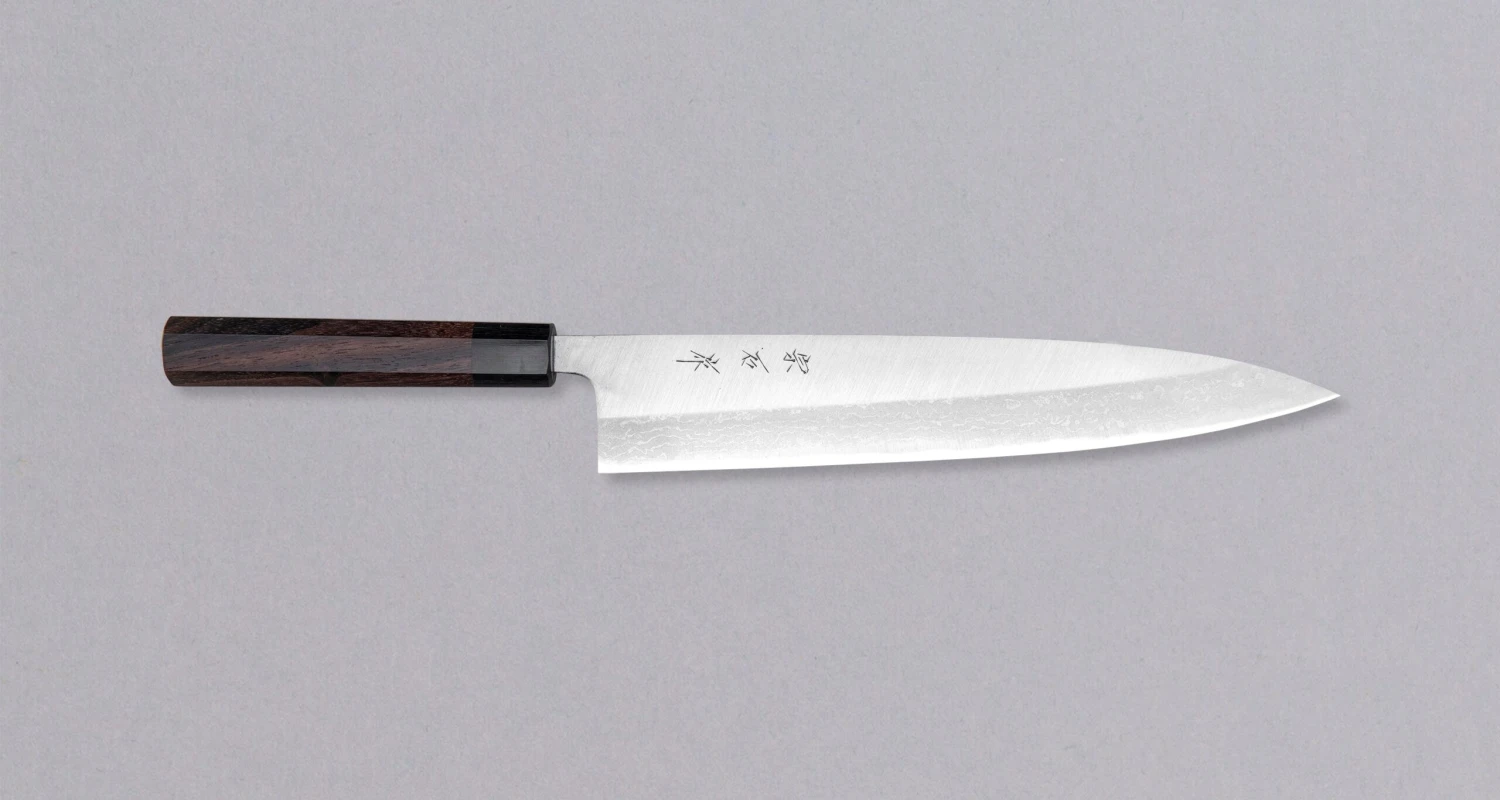
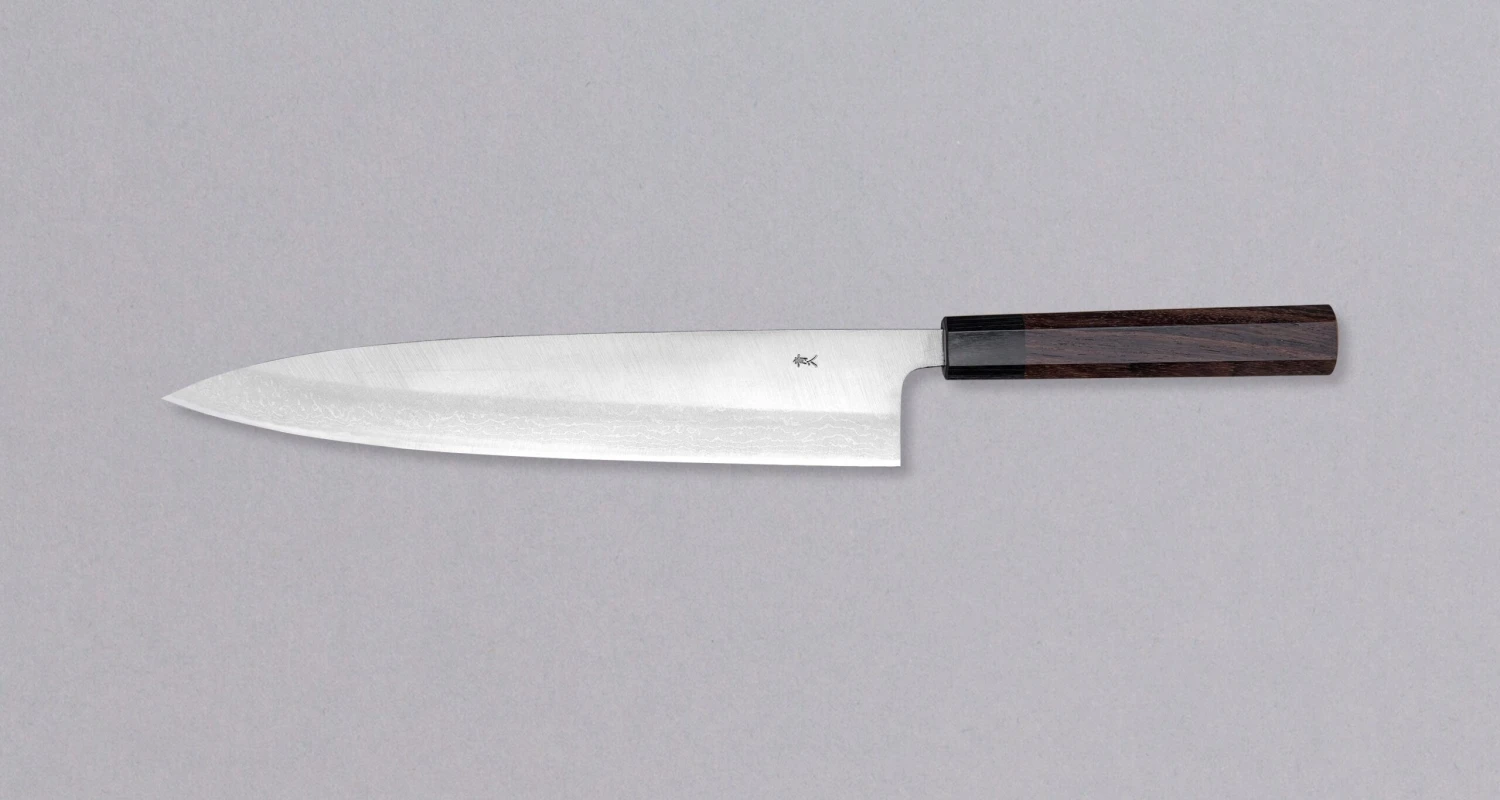
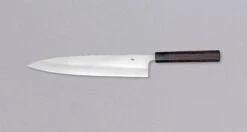
Muneishi Gyuto Damascus 270mm (10.6″)
Original price was: $310.00.$99.99Current price is: $99.99.
- Superior Quality Goods
- Multiple safe payment methods
- Shop the Best Quality Online
- Satisfaction Guaranteed

Muneishi Gyuto Damascus 270mm is a multi-purpose Japanese kitchen knife, suitable for preparing meat, fish and vegetables. This gyuto is kind of a 2in1 knife – its respectable length of 270mm enables it to be used as a slicer as well. It can go from chopping vegetables to slicing sashimi in no time. Not only that, but it’s also perfect for larger cuts of meat, whether that’s for trimming raw meat or slicing cooked steaks and larger roasts.
For such a large knife, it’s also quite light – meaning it will be a pleasure to use for longer periods of time and won’t really feel its size.
BLADE SHAPE:
Gyuto is the most versatile and useful blade shape in the modern kitchen. It has a wide profile for easy food transfer and tends to be fairly flat towards the heel, enabling easy and fast chopping on the cutting board. A pointed tip allows piercing and precise, delicate work. A slight curve between the tip and the midsection makes the belly great for rocking the blade back and forth when cutting. It can be used for cutting meat, fish and vegetables.
STEEL:
Aogami #2 steel is a very popular steel in Japanese knifemaking and one of the finest high-carbon steels, meaning the knives forged from it will have excellent edge retention and also sharpen very easily. At the same time, it is less resistant to corrosion, meaning the blade can develop a patina, while longer exposure to water or other corrosives could also lead to rusting. This is improved to some extent with the addition of chromium and tungsten, but it’s still a high-carbon steel that should be maintained accordingly. Aogami #2 steel is composed of carbon (C) 1.1 %, chromium (Cr) 0.5 %, manganese (Mn) 0.3%, and tungsten (W) 1.5%.
LAMINATION:
→ San-mai damascus
High-carbon steels are hard, but brittle for the same reason. This makes them more prone to breakage and chipping. To prevent that, blacksmiths sandwich the blade’s core, made from Aogami #2 steel, between two layers of softer steel. This improves the blade’s flexibility.
GEOMETRY:
It has a double bevel (symmetrical) blade..
BLADE FINISH:
The damascus pattern has only been treated on the lower part of the blade, and there is a clear line separating it from the upper, polished part of the blade. Kanji has been hand-chiseled onto the blade.
HANDLE:
Octagonal Japanese (Wa) handle made out of rosewood is suitable for right- and left-handed individuals.
BLACKSMITH:
Muneishi smithy was founded in 1955. Hirotaka Muneishi, the second-generation knife smith, is renowned for manufacturing forestry knives such as axes and machetes for the local woodsmen. Kosuke Muneishi, the third-generation blacksmith and now the head of the company, has since branched out to making kitchen knives. He mostly uses Aogami Super steel and performs all the steps himself: tempering, forging, hammering and sharpening knives. His knives have very nice grinds, good profile, and are very affordable.
Be the first to review “Muneishi Gyuto Damascus 270mm (10.6″)”
Related products


![Kotetsu Gyuto VG-10 Damascus 210mm (8.2") [pakka Wood]](https://www.sharpedge-shop.com/wp-content/uploads/2025/11/KotetsuGyutoVG-10Damascus210mm_8.2_pakkawood__200103121609-247x132.webp)
![Yu Kurosaki Gyuto Senko R2 270mm (10.6") [Rosewood]](https://www.sharpedge-shop.com/wp-content/uploads/2025/11/KurosakiGyutoSenko270mm_410103201222_1-247x132.webp)
![Nigara Sakimaru Sujihiki SG2 Kuro-uchi Tsuchime 300mm (11.8") [Ebony]](https://www.sharpedge-shop.com/wp-content/uploads/2025/11/NigaraSujihikiSG2KurouchiTsuchime300mm_11.8__Ebony__420110221614_1-247x132.webp)
Reviews
There are no reviews yet.